
Crude oil, inflation and the hidden cost of geopolitics
A war may be fought thousands of kilometres away, but its economic blast can reach the Indian household almost immediately. That is the central danger of the current West Asia tension for India. India Ratings and Research has projected that India’s growth may slow to 6.7% in FY 2026-27, citing the combined risks of West Asia instability, higher crude oil prices and the possibility of an El Nino impact on agriculture.
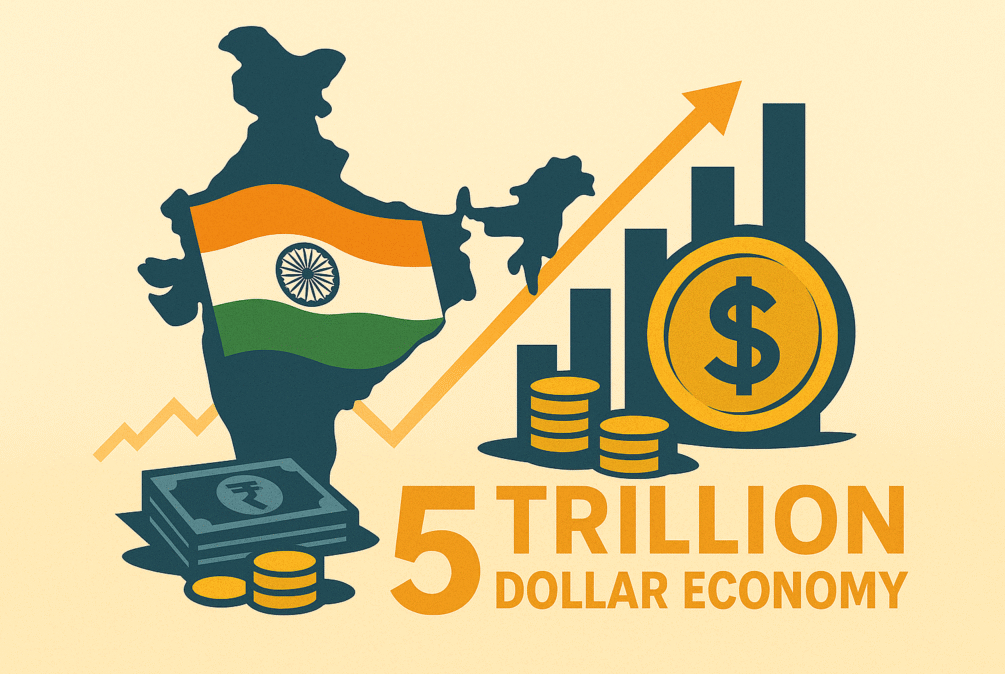
The headline number—6.7% growth—may still look respectable when compared with many large economies. But for India, which is racing against time to become a $5 trillion economy, even a small slowdown can matter. The question is not whether India will become a $5 trillion economy. The real question is: will the war, oil shock and inflation push that milestone one, two or even three years further away?
India’s oil dependence: the economy’s exposed nerve
India’s biggest vulnerability is crude oil. India is one of the world’s largest oil importers and its dependence on imported crude remains extremely high. Recent estimates and official-linked data show that India’s crude import dependence is close to 88–90% of consumption. This means every jump in international crude prices directly affects India’s import bill, current account deficit, rupee, fuel prices, transport costs and finally retail inflation.
When oil becomes costlier, the first hit comes through the import bill. India has to spend more dollars to buy the same quantity of crude. That puts pressure on the rupee. A weaker rupee then makes other imports more expensive, including fertilisers, chemicals, electronics, machinery and edible oils. This is how a geopolitical crisis becomes a domestic inflation crisis.
Reports suggest Indian refiners are already being forced to adjust crude sourcing and spot purchases because of supply disruption risks linked to the West Asia conflict. This is important because spot purchases during crisis periods are usually costlier and more uncertain than long-term contracts. In simple words, India may not only pay more for oil; it may also have to work harder to secure supply.
Inflation: the tax that hits the common man first
The most painful channel is inflation. A sustained crude oil shock increases the cost of diesel, petrol, LPG, aviation fuel and industrial energy. Diesel is especially important for India because it powers trucks, buses, agricultural pumps, construction machinery and parts of the logistics chain. Higher diesel costs make food, cement, steel, vegetables, milk and daily consumer goods costlier.
If El Nino weakens rainfall or damages crop output, food inflation may rise at the same time as fuel inflation. That is a dangerous combination. SBI Research, as cited in recent reporting, estimated that El Nino with drought could reduce GDP growth by around 20 basis points in a median case and up to 65 basis points in an extreme scenario.
This means India may face a double shock: costlier imported energy and weaker domestic farm output. For a country where food and fuel still occupy a large share of household budgets, such inflation reduces real purchasing power. People postpone purchases. Companies face higher input costs. The government faces pressure to cut taxes, increase subsidies or reduce capital spending. All three affect the growth path.
The $5 trillion target: delayed, not destroyed
India’s $5 trillion dream was originally projected as a 2025 milestone in official policy language. A PIB release from 2018 had spoken of India’s potential to become a $5 trillion economy by 2025. That timeline has already slipped because of the pandemic, rupee depreciation, global shocks and revisions in nominal GDP estimates.
The IMF’s latest public profile places India’s GDP at about $4.15 trillion in 2026, with projected real GDP growth around 6.5%. At that level, India needs roughly another $850 billion in nominal dollar GDP to cross $5 trillion. Under stable conditions, with strong real growth, moderate inflation and a reasonably stable rupee, India could reach that mark around 2028 or 2029.
But if crude oil remains high, the rupee weakens, inflation rises and growth slips from the 7% plus zone to around 6.5–6.7%, the milestone may be pushed back by one to two years. In a severe scenario—where oil prices remain elevated for many quarters, the Strait of Hormuz risk worsens, capital outflows increase and El Nino damages agriculture—the delay could stretch to two to three years.
So, the fair estimate is this: the West Asia crisis may not derail India’s $5 trillion dream, but it can delay it by 1–3 years depending on the depth and duration of the oil shock.
Why a small growth cut has a large impact
A slowdown from 7.2% to 6.7% may look like just half a percentage point. But in a $4 trillion economy, even 0.5 percentage point means tens of billions of dollars in lost annual output. More importantly, it affects compounding.
The $5 trillion target is not achieved by one year of high growth. It requires several years of uninterrupted expansion. Every oil shock interrupts that compounding cycle. It reduces corporate margins, slows private investment, raises government borrowing pressure and weakens consumption. If inflation remains sticky, the RBI may also have less room to cut interest rates. That keeps loans costlier for businesses, home buyers and small enterprises.
Sectors likely to feel the pressure
The first affected sectors will be transport, aviation, logistics, chemicals, paints, fertilisers, plastics and energy-intensive manufacturing. Agriculture may suffer from both diesel costs and weather disruption. FMCG companies may face higher packaging and freight costs. Automobile demand may weaken if fuel prices rise sharply. Infrastructure companies could face cost escalation in steel, cement and bitumen.
The common man will feel it through higher food prices, transport fares, school bus charges, LPG expenses, electricity tariffs and general household costs. This is why the angle “Distant war, direct pain” is economically accurate. The war may be far away, but the bill arrives at the Indian kitchen, petrol pump and market.
The policy challenge
India’s response must be three-fold. First, it must diversify crude sources and increase strategic reserves. Second, it must accelerate electric mobility, public transport and domestic renewable energy. Third, it must protect growth by maintaining infrastructure spending while controlling inflation.
India cannot control West Asia. It cannot control global crude prices. But it can reduce vulnerability. The lesson is clear: a $5 trillion economy cannot be built on imported energy insecurity. The dream remains alive, but the path has become costlier, longer and more uncertain.
The next 100 days will be crucial. If oil stabilises and the rupee holds, India may absorb the shock with only a limited delay. But if West Asia tensions deepen, crude rises further and El Nino damages crops, India’s $5 trillion target may move from a near-term milestone to a postponed promise.